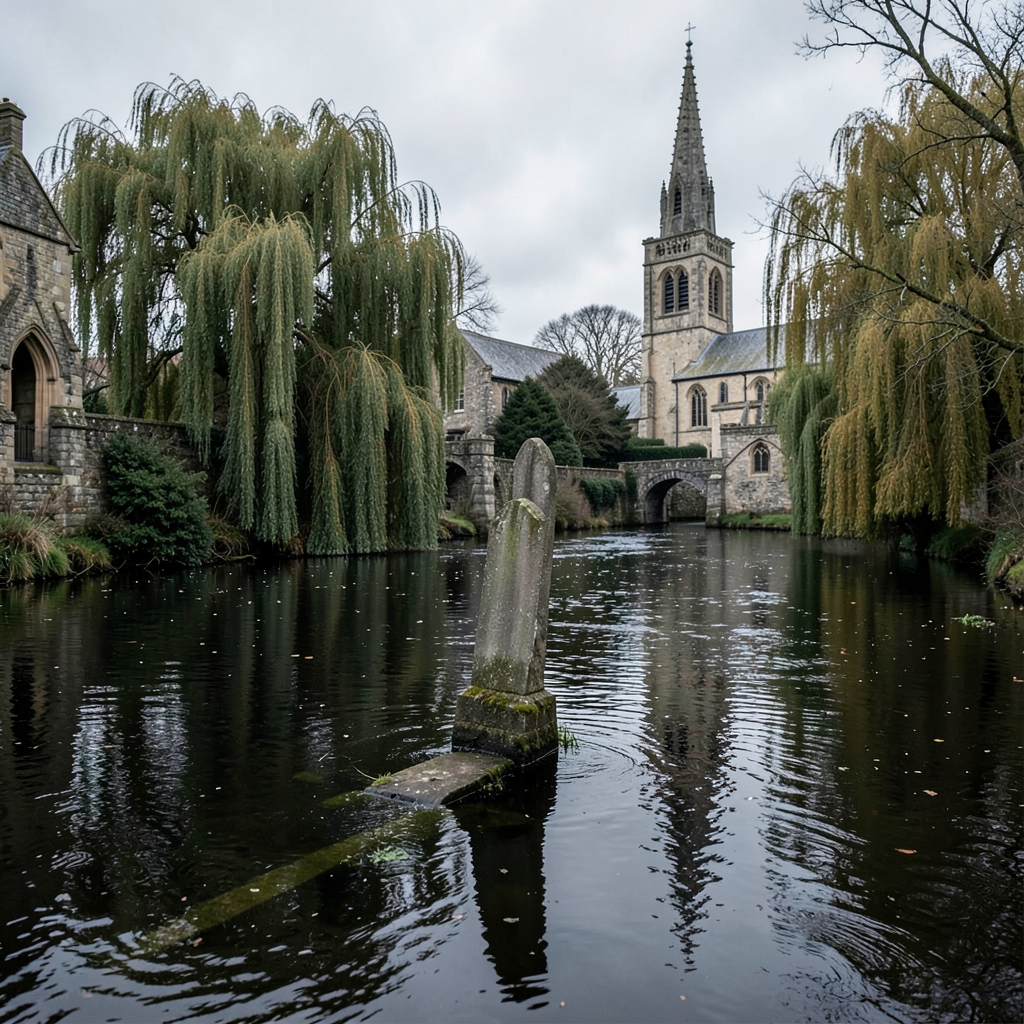

The body of 45-year-old Olive May Bennett was pulled from the deep, chilly waters of the River Avon in Stratford-upon-Avon, close to Shakespeare’s grave, during festivities honouring the renowned playwright.
The woman had met a grim fate that would have been at home in the Bard’s most violent works.
Described as an unassuming individual, Olive had been strangled before being weighted down with a gravestone torn from Holy Trinity churchyard – where Shakespeare himself was interred – to keep her submerged on the river floor.
Despite the involvement of Scotland Yard’s most celebrated detective, the Tombstone Murder remains unsolved more than seven decades after the midwife’s body was recovered. It remains a dark episode in Stratford-upon-Avon’s history.
The case still defies explanation despite News of the World offering a substantial £100,000 reward years after the disturbing discovery. Reports persist of the victim’s apparition wandering the riverbank, condemned to an eternity without resolution.
The 1954 case, now stone cold, is regarded as one of the most perplexing criminal investigations in the nation’s history, a mystery worthy of Agatha Christie. Unsurprisingly, it attracted international press attention, with Australia’s Townsville Daily Bulletin informing readers that people queueing for the first night of Romeo and Juliet at Stratford-upon-Avon saw murder hunt detectives pull a moss-covered gravestone from The Avon.
The small tombstone became a vital clue as detectives probed the death of a woman, drowned in the river near Shakespeare’s burial place. The police said that the tombstone may have been tied to the body of nurse Olive Bennett and that they had learned Nurse Bennett was an inoffensive little soul who was not known to have any men friends.
Subsequent press coverage painted a rather different portrait. Nurse Bennett apparently possessed a mischievous streak.
Olive, perceived as a shy, retiring individual during her lifetime, ignited a global media frenzy after her death.
The distinctive details that gradually came to light set this case apart from countless brutal killings.
Olive, a respected professional in her community, did not fit the typical profile of stalking victims. Offenders typically view sex workers, those vulnerable due to addictions, or individuals whose guard has been lowered by alcohol as easier targets.
In the days leading to her death, she told a hotel proprietor that someone was observing her, following her movements.
Although the unmarried woman was initially depicted as timid, later reports suggested she had succumbed to the pressures of midlife. In her forties, she began patronising pubs, smoking, and pursuing romantic relationships.
Then there is the most striking element: the gravestone. After strangling Olive with her own woollen scarf, the perpetrator or perpetrators wrenched the Victorian monument – weighing approximately two-and-a-half stone – from the packed earth at Holy Trinity. This would have demanded considerable time and effort.
A witness noticed the desecration, contacted authorities, and Olive’s remains surfaced on the morning of April 25, having broken free from their bindings. While investigators examined the scene, townspeople prepared for Shakespeare’s 390th birthday festivities.
Officers from the CID thoroughly searched the cemetery grounds under the supervision of leading detectives Superintendent Spooner and Capstick.
They were occupied with decorations, while the police were occupied with bloodshed.
The area bore traces of Olive’s frantic attempt to escape her attacker. Her lower dentures, spectacle case, and one shoe were discovered among the labyrinth of tombs. Her hat was found on a tree-lined footpath dubbed Lover’s Lane.
The gentle midwife had fought desperately for survival.
Gentle? In the few years before her death, Olive appeared to have grown considerably bolder, even daring. Her character underwent a dramatic transformation, if contemporary accounts are accurate. Originally from Scotland, she seemed determined to compensate for her conservative upbringing. Tabloid reports spoke of Olive’s diary documenting male companions, drinking sessions, a woman depleting her Post Office savings, and someone who had discovered cosmetics and fashion.
On the evening before her remains were discovered, Olive consumed schooners of sherry alone at multiple establishments, including the Red Horse Hotel on Bridge Street. In the early 1950s, it was uncommon for women to frequent bars unaccompanied. Doing so required nerve.
She was last spotted at 11.45pm outside the hotel by a night porter. She was walking anxiously, possibly arranging another romantic encounter.
Had she arranged to meet her murderer?
The body was examined by pathologist Derek Barrowcliff, and the Daily Telegraph, in a 2011 obituary for the man, published his postmortem conclusions that Olive Bennett’s woollen scarf had been used to anchor her body to a heavy Victorian tombstone that had been uprooted from the graveyard at Holy Trinity Church and thrown into the nearby river. The obituary noted that Barrowcliff was appointed a Home Office pathologist on the strength of his work on this baffling case.
Initially, the inquiry was led by Superintendent Alec William Spooner of Nuneaton Police before being transferred to The Yard’s Detective Chief Superintendent John Capstick, a tough operator willing to bend or even violate procedures to achieve results.
A veteran of the celebrated Ghost Squad established to dismantle organised crime, Capstick employed methods that would make The Sweeney uncomfortable.
Just two years before receiving the Stratford assignment, he had been tasked with solving the murder of a 19-year-old girl in Northern Ireland.
Over several days of intense questioning without legal representation, suspect Iain Hay Gordon experienced the full weight of Capstick’s interrogation methods.
The 20-year-old military man was reportedly informed to confess – or Capstick would inform his parents their son was gay. During that era, homosexuality constituted a criminal offence.
Gordon eventually broke, though his signed confession has been characterised as oddly detached, containing the phrase I believe I did this.
In 2000, following the Court of Appeal learning that Capstick had committed perjury, Gordon’s conviction was overturned.
That was the aggressive enforcer brought in to solve Olive’s murder.
Novel, even pioneering, strategies were deployed. On May 13, 1954, the Dundee Courier’s front page reported that police may ask for TV help as the hunt for the man who strangled Miss Olive Bennett spread yesterday to Manchester.
Members of local social clubs were also questioned as investigators pursued a theory that Olive might have encountered her killer at such a venue.
Eight years passed before a notable breakthrough occurred, and the reason the two women who provided it remained silent for so long remains unclear.
They informed detectives that on the night Olive died, they were in the cemetery with two soldiers. One made an unsettling threat to weigh them down with a tombstone, a statement that seems more than coincidental.
In 1984 renewed interest emerged when Vancouver police contacted Scotland Yard after a former serviceman was questioned regarding traffic violations. Without prompting, he began discussing an old murder in Stratford-upon-Avon.
That lead yielded no results.
Some believe Olive’s death bears the characteristics of a serial killer, yet one infamous name connected to the case can be eliminated.
John Christie, the 10 Rillington Place monster who preyed on tenants and prostitutes, was apprehended a month before the Tombstone Murder and executed in July 1953.
There are parallels with the methods of Jack the Stripper, never identified but believed responsible for six West London killings between 1964 and 1965 – and deaths stretching back considerably further.
All his victims were strangled, many were positioned near the River Thames. The distinctions are marked, however. Jack exclusively targeted prostitutes, left them nude, and kept their personal effects as trophies.
The Tombstone investigation concluded long ago, and what happened to Olive has become merely another bizarre Warwickshire murder in a county with an unfortunate reputation for peculiar killings.
The unsolved 1945 demise of Charles Walton, a farm worker some in Lower Quinton believed possessed supernatural abilities, is the most bizarre. He was discovered, impaled to the earth by a pitchfork, his throat cut, in a scene reminiscent of an occult ritual.
Superintendent Alec William Spooner, originally overseeing the Olive May Bennett inquiry, was involved in that case as well. The man must have yearned for a straightforward shooting or stabbing rather than being confronted with a stream of Midsomer Murders-style mysteries.
Who murdered Olive?
Judging by the reported ghostly appearances, she is most eager to see the perpetrator brought to justice.
Writing for the paranormal website Mysterious Britain, author Ian noted that he had not come across a first-hand account of an experienced encounter with this ghost, but he had found a reference of people seeing a woman stood in the water and of people jumping off boats trying to save her as they thought she was drowning.
One individual even plunged in fully clothed from the shoreline in an attempt to rescue Olive.
For those who believe in the spirit world, her ghost seeks closure, demands her killer or killers be exposed.
For those who believe in the power of a substantial £100,000 reward that still failed to loosen tongues, her spirit is unlikely to obtain it.