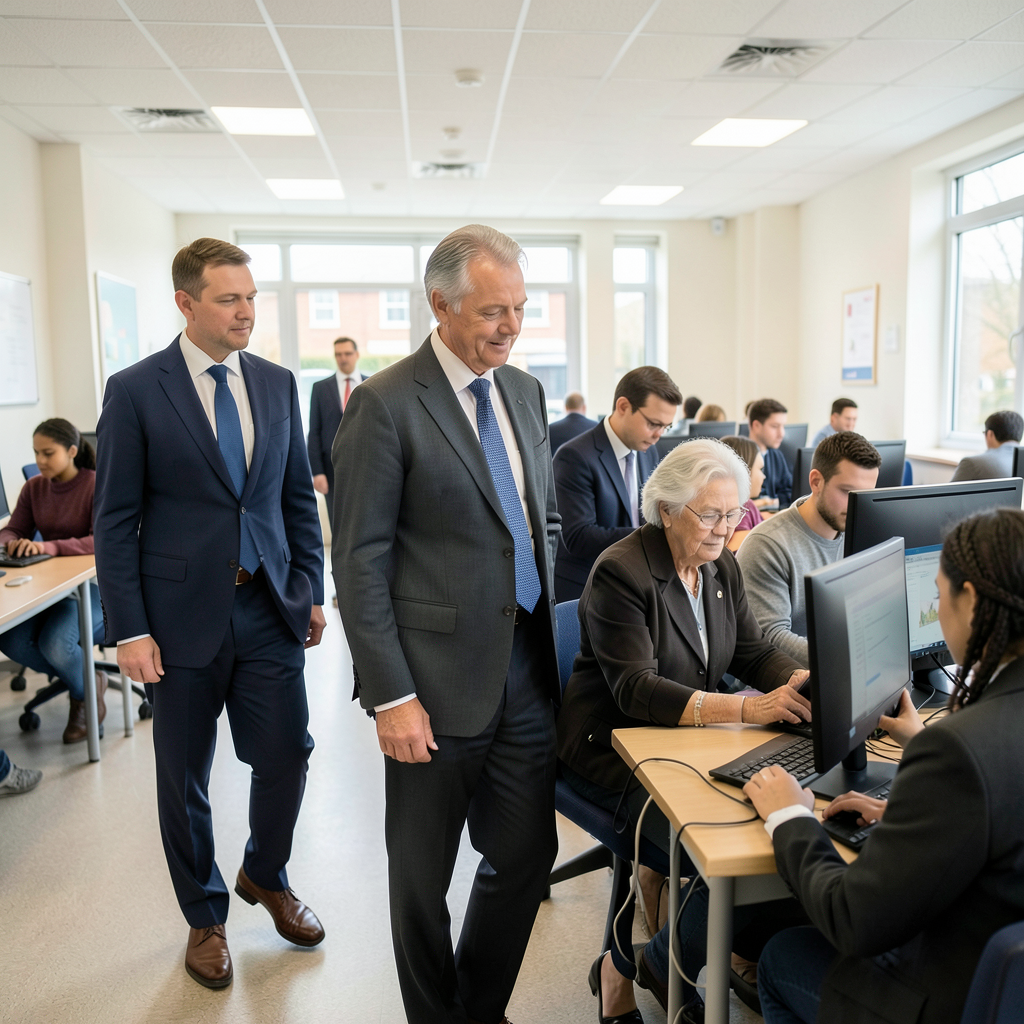

The initiative enables local residents to connect online, find opportunities and enhance their circumstances.
The tour demonstrated how the Council, businesses, voluntary organisations, health providers and educational institutions are working together to address digital exclusion throughout the city. An important element was the Strategic Policy Roundtable titled Digital Inclusion as Essential Infrastructure. This session examined how digital inclusion could be treated and resourced as a basic necessity rather than through temporary schemes.
Representatives from the Department for Digital, Culture, Media and Sport visited three locations: Friargate One, the Central England Law Centre and The House Project, which assists young people leaving care to establish independent, connected lives. The tour concluded at the Council House premises, where officials worked alongside technicians to repair donated equipment and observe how technology is being restored to benefit local residents.
Paul Ward, Director of Digital Services, stated that the visit showcased the excellent work carried out by the Central England Law Centre and partner organisations, along with the genuine impact being achieved for local people. It also illustrated the strength of the partnership with Virgin Media O2 and what can be accomplished when organisations unite behind a common purpose.
He added that this was a worthwhile chance to explore how local and national government can collaborate with communities and delivery partners to build upon existing successful approaches, helping effective methods reach more people. The objective is straightforward: everyone should have access to the digital technology, skills and connectivity required to participate fully in contemporary life. In a world where digital interaction is increasingly prevalent, this access is becoming as fundamental as any other essential service.